Japan taps into rare earth minerals in deep-sea amid rising tensions with China

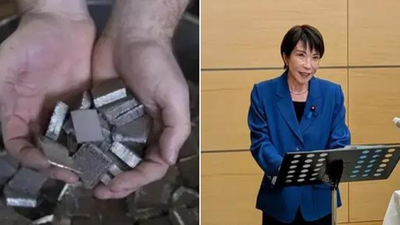
Japan reported having found sediments containing rare earth in the 6,000 metre deep-sea beds after launching the expedition to restraint the dependency on China for valuable minerals. The government claims this expedition to be the world’s first ever attempt to dig for rare earth minerals at such a depth.Government spokesperson Kei Sato stated that the details are yet to be analysed. He also claimed that the mission and its achievements shall benefit Japan’s economic security and development.
“Details will be analysed, including exactly how much rare earth is contained. (This is) a meaningful achievement both in terms of economic security and comprehensive maritime development,” he said.Japan carried out the mission near its remote Minami Torishima island. It is a region believed to hold the world’s largest reserves of rare earth minerals. It is a move that is seen as Tokyo’s bid to bolster its resource security amid rising tensions with China.The samples were gathered by the scientific drilling ship Chikyu, which set sail last month for the Pacific island area located within Japan’s exclusive economic zone.The mission comes as Beijing, the world’s dominant supplier of rare earths, has stepped up pressure on Japan following remarks by Prime Minister Sanae Takaichi suggesting Tokyo could respond militarily to any Chinese attack on Taiwan.China has since restricted exports of so-called “dual-use” items to Japan—goods with potential military applications—raising concerns in Tokyo that Beijing could also curb supplies of rare earth elements critical to advanced manufacturing and defence technologies.Rare earths, a group of 17 metals that are difficult to extract, are essential for products ranging from electric vehicles and wind turbines to hard drives and missile systems.According to estimates cited by the Nikkei business daily, the seabed around Minami Torishima contains more than 16 million tonnes of rare earth deposits, making it the world’s third-largest known reserve.The area alone is believed to hold enough dysprosium to meet global demand for over seven centuries, as well as nearly eight centuries’ worth of yttrium—materials vital for high-performance magnets, electronics and laser technologies.


