‘Indian is not an insult’: UAE analyst Amjad Taha’s viral response schools Saudi trolls on racism

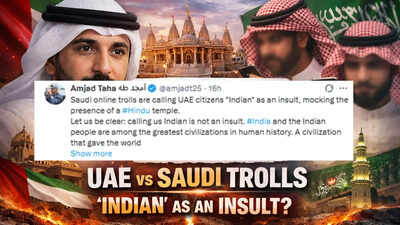
A viral tweet by Emirati political analyst Amjad Taha has ignited a broader online conversation about identity, racism and regional tensions after some Saudi social media users used “Indian” as an insult towards UAE citizens in the context of celebrating a Hindu temple opening in the Emirates. Taha’s response of defending India’s civilisational contributions and calling for mutual respect has sparked a deeper debate about cultural pride, xenophobia and Gulf-Arab relations in the digital age.This is not just a passing exchange of tweets. It reflects long-running cultural tensions and the power of online narratives in shaping public perceptions between neighbouring countries in the Middle East and South Asia.
What Sparked the Online Backlash?
The immediate cause was a wave of derogatory comments on social media by a subset of Saudi users, who mocked UAE’s decision to allow the construction of a Hindu temple, a move seen by many observers as a sign of the UAE’s commitment to religious tolerance. Some of these comments included calling Emiratis “Indian” as a pejorative, a misuse of identity intended to insult rather than describe.This reaction likely stems from broader political and cultural frictions that occasionally surface between Gulf countries on social platforms, often tied to regional politics, national pride and domestic audiences. Observers note that such rhetoric is not new since when tensions rise, for example over foreign policies or regional conflicts, racial or national labels can be weaponised online in ways that deepen divisions rather than reflect broader public sentiment.
Amjad Taha’s response: Turning insult into a lesson on civilisation
Rather than retaliating, Amjad Taha (@amjadt25) took a very different tone in his tweet. He argued that being called “Indian” should not be considered an insult and pointed out that India’s contributions to humanity through mathematics, philosophy, medicine and spirituality rank among the greatest civilisations in history.
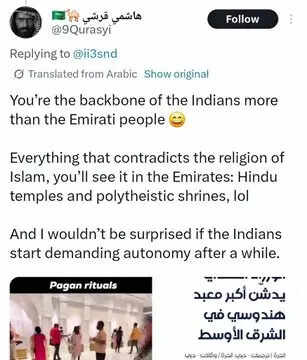
UAE Saudi Twitter Dispute: Indian Identity, Racism and Regional Tensions Erupt Online
Taking to his X (formerly Twitter) handle, he shared a screenshot of a hate message and tweeted, “Saudi online trolls are calling UAE citizens “Indian” as an insult, mocking the presence of a #Hindu temple. Let us be clear: calling us Indian is not an insult. #India and the Indian people are among the greatest civilizations in human history. A civilization that gave the world mathematics, philosophy, medicine, and spiritual depth long before many modern states existed. We live with India, work with India, grow with India, and respect India (sic).”He added, “What is truly shameful is not the UAE’s openness, but the racism shown by #Saudi trolls toward Indians, a people they rely on economically yet look down on online. This is not strength; this is moral weakness (sic).”Taha’s message drew upon the ancient Indian notion of “Vasudhaiva Kutumbakam”, the idea that the world is one family, as a moral lens to challenge racism and celebrate shared human heritage. By invoking Vasudhaiva Kutumbakam, a Sanskrit phrase popularised in diplomatic discourse and often cited in Indian foreign policy rhetoric, Taha sought to shift the narrative from one of insult to one of mutual respect and civilisational pride.He wrote, “As Indian wisdom teaches us: Vasudhaiva Kutumbakam ..The world is one family. #Hindus are proud not because they shout, but because they know who they are. Civilizations do not need insults to feel strong. They stand on knowledge, respect, and time.And history always remembers which civilizations built and which only mocked (sic).”
Gulf social media amplifies identity politics
Online platforms like X are key venues for political and cultural expression in the Gulf, where youth-driven engagement often amplifies polarising content. What might begin as a fringe comment can quickly become a viral flashpoint, shaping perceptions far beyond the original intent. The episode reflects how national identities, especially in multi-national regions like the Gulf (where large Indian diasporas coexist with Arab populations), can be misused in online hostility, even in highly interconnected societies.
Saudi online trolls are calling UAE citizens “Indian” as an insult, mocking the presence of a #Hindu temple.
Let us be clear: calling us Indian is not an insult. #India and the Indian people are among the greatest civilizations in human history. A civilization that gave the world… pic.twitter.com/peYbiR3NvF— Amjad Taha أمجد طه (@amjadt25) February 2, 2026


