Siren: meaning, etymology, myth and why the sound still owns you |
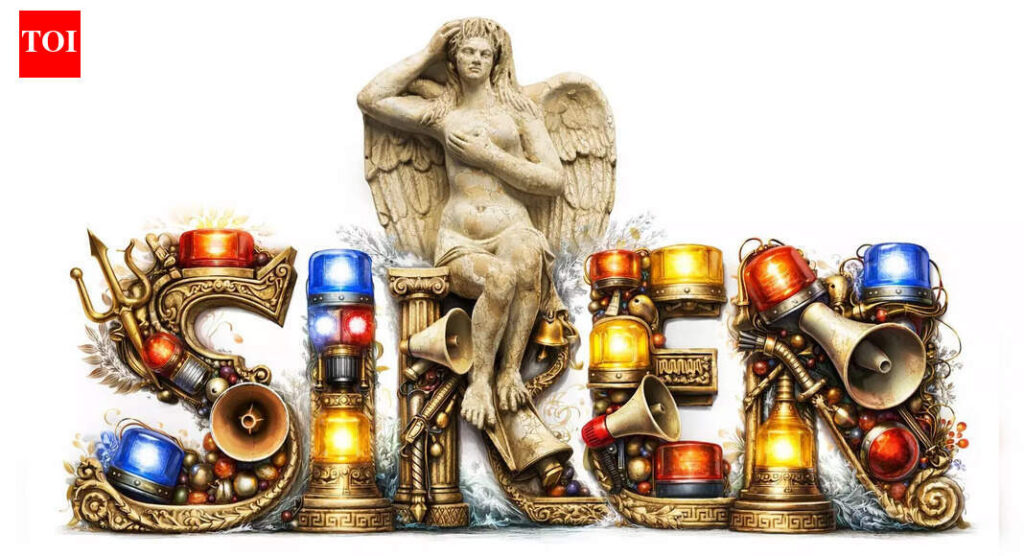

The Wordle word of the December 31, 2025 is siren, a word that has survived by learning how to travel. It begins in myth, migrates into machinery, embeds itself in language, and ends up inside the nervous system. Few words have managed that journey without losing coherence. Siren has, because it has always meant the same thing: a call that overrides choice.Not persuasion. Not argument. Override.
Where the word comes from
Siren enters English through Latin sīrēn, from the Greek Seirēn. In its earliest form, it names the mythic beings themselves. The etymology does not point to beauty or danger so much as compulsion. A siren is not something you agree with. It is something you respond to.That distinction matters, because it explains why the word adapts so easily to modern life.
The sirens of myth
In Greek mythology, the Sirens are not mermaids in the soft-focus sense. They are closer to instruments with faces. Their power is not physical. It is auditory. They sing. Sailors hear the song. And what follows is not a conscious decision but a drift. Curiosity becomes certainty. Certainty becomes collision. The sea finishes the sentence. Odysseus treats this less like a moral challenge and more like a systems problem. He wants to hear the song, because knowledge matters, but he also knows that future-him cannot be trusted. So he has his crew block their ears and tie him to the mast, instructing them not to listen to him later.This is the Ulysses pact before behavioural economics gave it a name. Present-you builds restraints because future-you will lie. The Sirens, in that moment, stop being monsters and become diagnosis.
From myth to machinery
When the word siren moves into modern language, it does not change character. It simply sheds feathers and acquires wiring.Police sirens, ambulance sirens, fire alarms, factory alerts, nuclear warning systems, coastal flood sirens. All operate on the same principle. The sound is designed not to inform, but to command. It cuts through walls, traffic, conversation and sleep. You respond before you understand. Often before you locate the source.Even when you have done nothing wrong, a siren can make your body behave as if you have. Heart rate spikes. Thought narrows. Space reorganises itself around urgency. The ancient Sirens pulled sailors off course. The modern siren forces you onto one.
Siren as metaphor and method
This is why “siren song” has become such a durable metaphor. It describes temptation that does not feel like temptation. It feels like clarity. Like inevitability. Like something obvious that everyone else is missing. Markets have sirens. So does politics. So does technology.Flash sales, push notifications, autoplay, infinite scroll. These are not arguments. They are attention hacks. They operate on rhythm and repetition, not persuasion. You do not decide to engage. You react. The sound may be visual now, or haptic, or algorithmic, but the logic is unchanged.
Sisyphus with headphones on
This is where Sisyphus enters, not as a named-drop but as a structure of repetition. Sisyphus pushes the boulder up the hill knowing it will roll back down. The siren is often the promise that this time will be different. The next scroll. The next alert. The next certainty.You chase the sound. You reach it. It resets. You chase again. The Sirens never needed to kill you. They only needed to keep you listening.
Other lives of the word
Siren now operates across domains without losing its core meaning. In literature, it describes characters or ideas that pull others toward ruin while appearing luminous. Ambition is a siren. Power is a siren. Even nostalgia can be one. In music and film, siren-like sounds are used to induce tension and urgency, rising tones that never quite resolve, keeping the listener alert, anxious, expectant. In pop culture, the word sometimes attaches to people who draw attention effortlessly, not through persuasion but gravity. Focus gathers. Behaviour changes. Across all these uses, the mechanism is identical. Something calls. Resistance weakens. Choice narrows.
Pronunciation
It is usually pronounced SY-rən, with the stress on the first syllable. The second fades quickly, almost swallowed. The word sounds like what it describes: sharp at the start, inevitable at the end.
Using siren in sentences
- The siren cut through traffic, turning the street into a corridor of compliance.
- He recognised it as a siren song, and still leaned closer, as if clarity would make it safe.
- The city’s sirens began at dusk and never truly stopped, only rotated.
- The app was a siren dressed as convenience, promising calm while feeding compulsion.
Why the word still holds
Siren endures because it names a specific kind of power: the power to interrupt the self. In myth, it interrupts the sailor. In the city, it interrupts the citizen. In culture, it interrupts judgement. A good word does not just describe an object. It explains a pattern. And siren explains what happens when sound, desire and authority discover they can all use the same frequency.