Bendable elbows to fidget spinner: Mattel’s new autistic Barbie is winning hearts online
Mattel, one of the most popular US toy manufacturers, unveiled its first-ever autistic Barbie on January 11, 2026. The doll hit the shelves on January 12th and ever since, the internet has been in love with the inclusive and representative toy. Around one in thirty-one, 8-year-old American children have been identified with Autism Spectrum Disorder (ASD), as per the CDC’s ADDM Network. According to the Mayo Clinic, ASD affects brain development and impacts how people perceive others and interact socially. However, each child with the disorder is likely to have a unique pattern and in a world where inclusivity and representation are rising ideals in life, the new launch has been much welcomed in the market.
Mattel’s new autistic Barbie
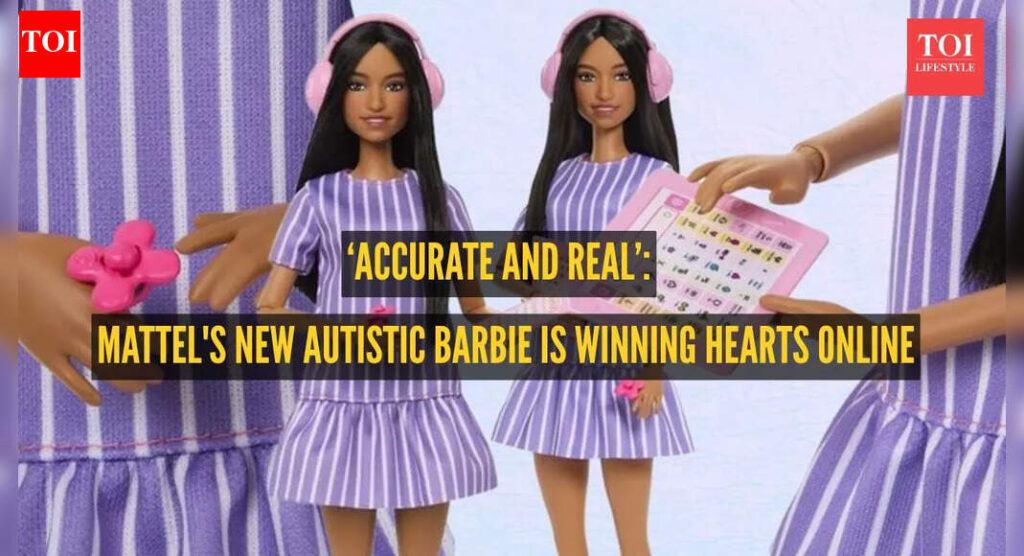
The new autistic Barbie has numerous interesting features and aspects. Its eyes gaze slightly to one side, reflecting how some autistic people avoid direct eye contact.
- She has completely bendable elbows and wrists, allowing movements like stimming and hand-flapping that help many people with autism to express emotions.
- Developed over a period of 18 months, it has a pink finger clip fidget spinner, noise-cancelling headphones and a tablet. Items that people with autism may use to improve focus and reduce stress.
- Her attire is a loose, purple pinstripe dress with short sleeves and a flowy skirt to allow comfort.
- Completing the outfit are purple shoes with flat soles to increase stability and ease of movement.
Netizens react to Mattel’s autistic Barbie
Girls are three times less likely to be diagnosed with autism, as per a 2017 study published in JAACAP. The new doll shines light on the experiences of autistic girls that are often ignored. And people on the internet are coming out to support the initiative and launch. “They made an autistic Barbie and she’s looking at the ground (accurate and real),” appreciated one X user.“Their new one has accessories that autistic children often use. That’s such a big deal, when they’re often othered in social settings,” pointed another. “Fair play, for such a massive company, it’s lush to see how hard @Barbie are working to make dolls that represent a wide variety of kids,” one wrote.“Love the details on this Barbie.. headphones for focus and spinner for calm. Mattel nailed the representation. reminds me how owning what makes you unique just draws ppl right in” pointed out another social media user.
Mattel’s inclusive aim
Jamie Cygielman, the global head of dolls at Mattel stated that the new Barbie was the latest expansion of the company’s commitment to representation and inclusion. “Barbie has always strived to reflect the world kids see and the possibilities they imagine, and we’re proud to introduce our first autistic Barbie as part of that ongoing work,” she said.The doll expands what inclusion “looks like in the toy aisle and beyond” because every child deserves to see themselves in Barbie, she added. Interestingly, Barbie has been created in collaboration with the Autistic Self Advocacy Network, a US charity to represent the ways children with autism may experience, process and communicate with the world. “We engaged with the autistic community throughout the design process, always mindful that autism is experienced differently by every individual and is not always visible. The elements of this doll reflect how some people on the spectrum may experience and express the world, and we hope that by partnering with influential voices within the community, Barbie can continue to showcase a broader range of authentic experiences,” said Cygielman.“She is showing young girls that it is OK to be autistic, it is OK to be different, and it is OK to wear those differences with pride,” said Ellie Middleton, author and founder of an online community for neurodivergent people to The Guardian, hoping that the Barbie will challenge some misconceptions around autism.