MoEF affidavit to Supreme Court noted wide variations in Aravali height, yet proposed 100m definition | Gurgaon News
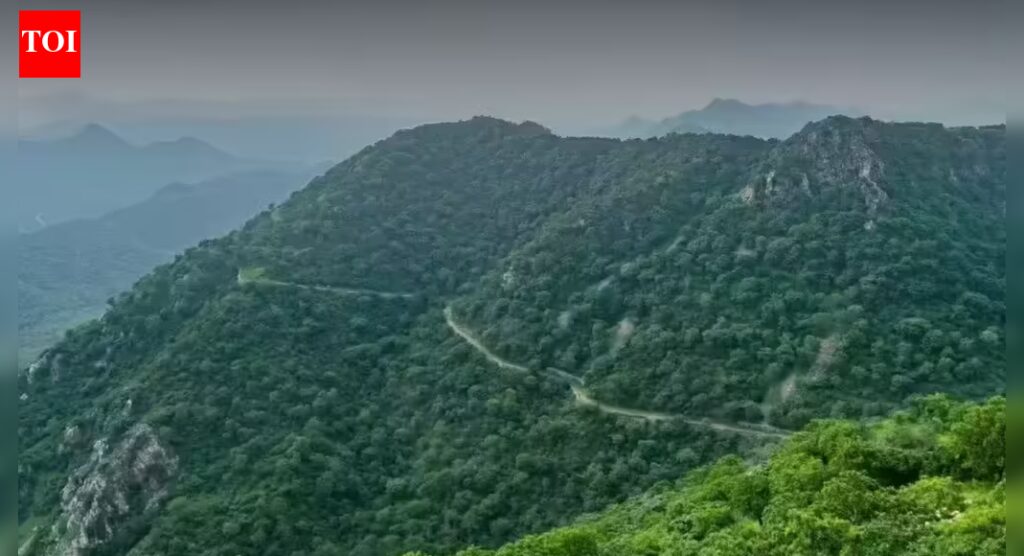
GURGAON: The Union environment ministry (MoEF) affidavit in Supreme Court, which recommended defining Aravalis for the purpose of mining as hills with an elevation of 100 metres or more, also noted that height and slope are insufficient parameters in delineating what constitutes Aravali hills and ranges.Supreme Court adopted the definition on Nov 20. But subsequent protests in Rajasthan have prompted the Centre to issue multiple clarifications on continuing mining restrictions in Aravalis.
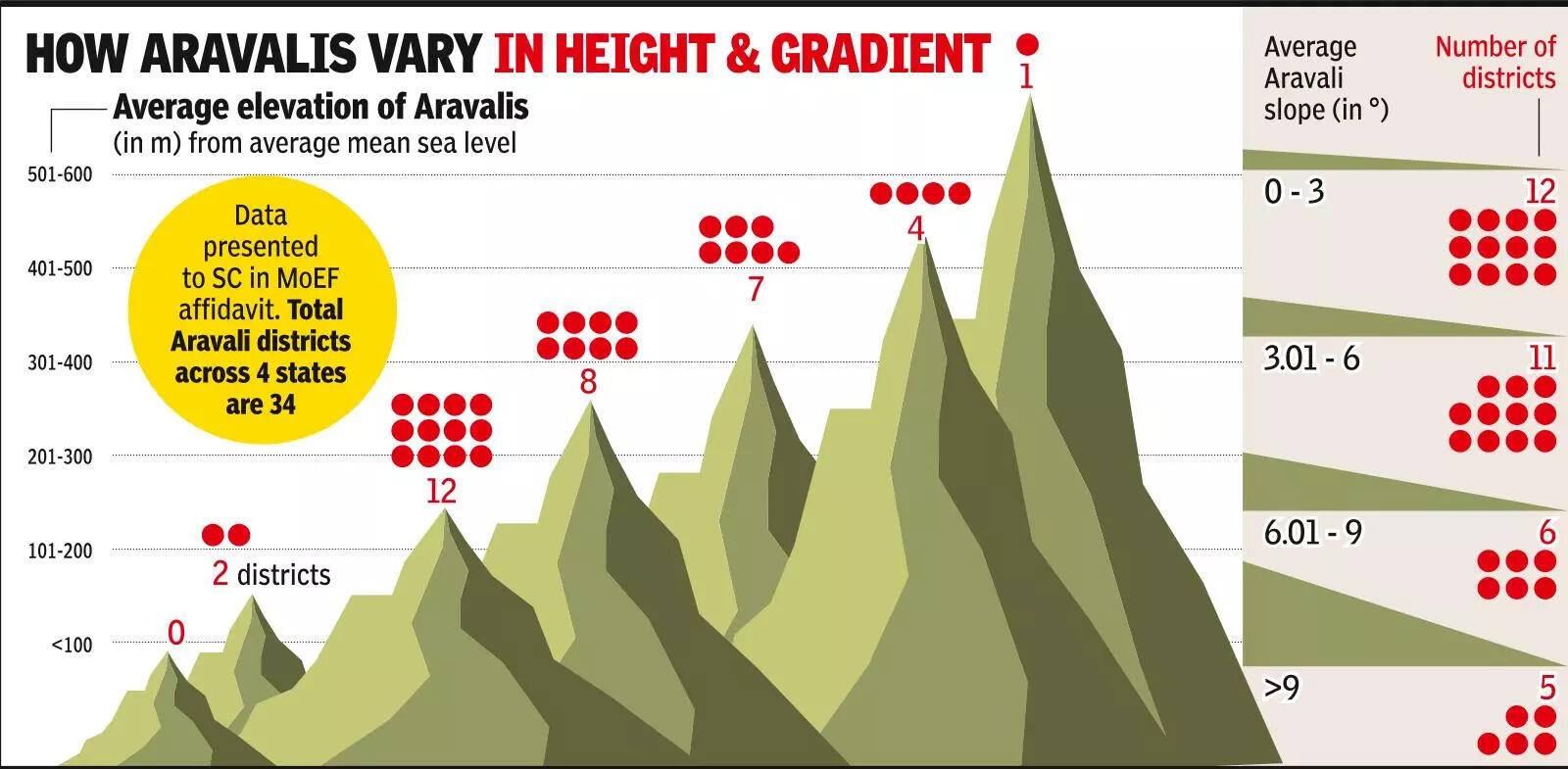
The affidavit underlines the inherent contradictions in the exercise to come up with a uniform definition for a heterogenous hill range with wide variations in character across the four states it passes through – Gujarat, Rajasthan, Haryana and Delhi.The document shows how the ministry’s technical panel, which was tasked with framing the definition, used the process of elimination to arrive at its goal but doesn’t explain how the 100m elevation logic weighs up against all the other parameters it discarded. It also doesn’t throw any light on how such a definition would protect the already degraded Aravali ranges from further damage, which is what the purpose of the court-mandated exercise was.In the affidavit, the ministry records that the committee asked Survey of India to analyse variation in slope and elevation across 34 districts identified as part of the Aravali system based on inputs from state govts and Geological Survey of India. District-wise elevation of Aravali hills and ranges was calculated from average mean sea level, with minimum, maximum and average elevations computed for each district.The survey showed major elevation variations, leading the ministry panel to conclude that Aravali hills and ranges “are not confined to high-altitude terrain, but rather span a wide range of elevation classes”. Aravalis in 14 of the 34 districts have an average elevation of 101-300m from the mean sea level, which shows nearly 40% of the ranges are low-lying. The hills in another 15 districts have an elevation between 301 and 500m. They are above 500m in just 4 districts and above 600m in one.The notion of elevation changes when seen relatively with the local land mass. If one considers the capital and its immediate neighbourhood, Delhi, Gurgaon, Faridabad, Nuh and Alwar are all situated at 200-300m from average mean sea level.The 100m definition proposed by the ministry panel and adopted by the court is not from average mean sea level but local relief (meaning landmass in the immediate vicinity) This is why Aravali watchers and legal experts fear that such a marker will exclude most of the ranges from a definition, even if that is for the purpose of mining, and therefore undermine conservation efforts.The affidavit, in fact, explicitly notes that “although average elevation is often used as a broad indicator for a hill”, in the case of the Aravalis, “a sole criterion cannot suffice” and would lead to “inclusion and exclusion error” given the “considerable internal variation in terrain”. Slopes, which experts say offer a better way scientifically of understanding hill systems, were also analysed and it threw up the same heterogeneity. Using contour data from Survey of India maps, the panel recorded that 12 districts have average slopes between 0 and 3 degrees and another 11 districts between 3 and 6 degrees. In effect, 23 of the 34 districts are dominated by gentle gradients, while only five districts show average slopes steeper than 9 degrees. Even while presenting this data, the affidavit cautions that slope alone as a defining criterion may also lead to errors.
Heterogenous Nature Of Ecologically Critical Ranges Find Repeated Mention
Debadityo Sinha, lead for climate and ecosystems at Vidhi Centre for Legal Policy, said the affidavit raises serious methodological concerns. “The committee relied on district-wise average elevation of grid cells, which is problematic given that Aravalis comprise thousands of hills. In a landscape with such high variation, averages can be misleading. A few very high hills can push the average close to 100m even if a large number of hills falls well below that mark. The real question is how many hills actually lie below 100 metres. The entire discussion is centred on the 100m cutoff, while the data relied upon is based on averages,” he said. From a statistical perspective, Sinha added, averages lose relevance when variation is extremely high. “In such cases, you examine distributions, medians or ranges. Here, hill heights vary widely, with some exceeding 600 metres. Using average elevation to justify a 100-metre threshold raises serious questions about the scientific validity of the approach,” he said. Former South Haryana conservator of forests MD Sinha said, “Forest Survey of India adopted the three-degree slope on a scientific basis after finding that wherever land consistently attains a slope of three degrees, it culminates in a hill, while gentler slopes lead to plains. On that basis, nearly four million hectares were identified as Aravali foothills,” he said, adding if that criterion, which had earlier been placed before the court, was rejected, it needed to be replaced with an equally scientific one. “If you discard a scientifically tested slope-based approach, you cannot substitute it with a thumb-rule like 100m. Why 100 and not 95 or 105? The scientific way would have been to ask FSI to present a comparative assessment showing how much area is covered under the three-degree slope criterion and how much under the 100m height rule, and place both before the court,” the former forester explained. He also pointed to internal inconsistencies in the affidavit on elevation.