Arctic security or minerals: Why Trump really wants Greenland; explained
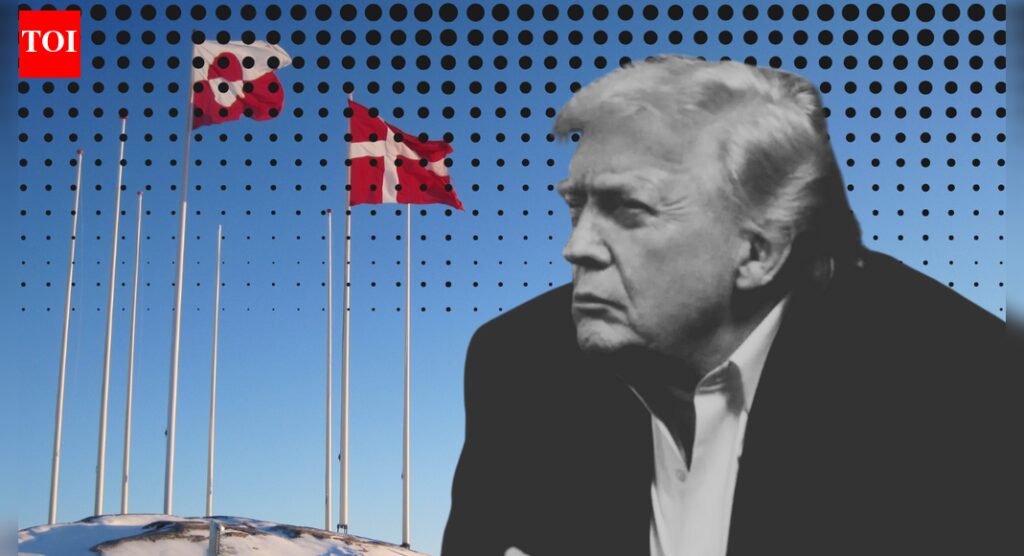
US President Donald Trump has doubled down on his long-standing ambition to “buy” Greenland.The deal was once dismissed as an eccentric real estate deal in 2019; however, Trump has consistently expressed his “strategic” interest in the area, exploring prospects to buy the self-governed territory from Denmark. He has consistently framed the island’s acquisition as an “absolute necessity” for American survival.Greenland, however, has stood firm on its stance, “Greenland is not for sale.”Trump has repeatedly claimed that the US needs Greenland for national security and not for its minerals. So how exactly does Greenland strategically matters for the US?
Greenland’s geographical location
Greenland sits off Canada’s northeast coast and stretches deep into the Arctic Circle, placing it right on the shortest routes between North America and Europe. For a president who frames foreign policy around defending the US homeland and projecting strength, that geography is hard to ignore.The US has treated Greenland as strategically vital since World War II, when Washington moved to prevent Nazi Germany from gaining a foothold in the North Atlantic. For Trump’s worldview—where choke points, shipping lanes, and military positioning define power—Greenland looks like a natural extension of US strategic depth.
The Arctic race
After the Cold War, the Arctic was often framed as a zone of cooperation. But as climate change thins sea ice, new shipping routes and easier access to Arctic resources are turning the region into a competition space again.That shift feeds directly into Trump’s core argument that rivals exploit openings while the US hesitates. A more navigable Arctic increases the strategic value of Greenland as a platform for monitoring and responding to Russian activity and for protecting North Atlantic routes that could become more economically significant.
Rare earths
Greenland holds deposits of rare earth minerals used in phones, computers, batteries, and advanced defence technology. Trump has repeatedly focused on economic nationalism and reducing reliance on China in critical supply chains.From that perspective, Greenland represents a potential way—at least in theory—to loosen China’s grip on rare earth processing and supply. The problem is that extraction is difficult due to Greenland’s harsh climate, and environmental restrictions can slow or block projects—exactly the kind of barrier Trump often criticises as “red tape.”
A built-in US military foothold
The US already operates the Pituffik Space Base (formerly Thule Air Base) in northwestern Greenland under a 1951 defence agreement with Denmark. The base supports missile warning, missile defence, and space surveillance—capabilities that fit squarely into Trump-era messaging about defending America from emerging threats.Greenland also sits near the GIUK Gap (Greenland–Iceland–UK), a key corridor where NATO tracks Russian naval movement in the North Atlantic. In Trump’s strategic framing, controlling and strengthening monitoring in these corridors is about deterrence and “not letting Russia get ahead.”
Leverage over NATO
Trump’s approach to alliances often emphasises burden-sharing and hard bargaining. Greenland, while self-governing, is part of the Kingdom of Denmark—meaning any bigger US role there forces negotiations with Copenhagen and intersects with NATO politics.Denmark has been strengthening its Arctic posture with new vessels, drones, and surveillance upgrades, and it runs Arctic command operations out of Nuuk. But for Trump, Denmark’s moves can still look like “not enough,” reinforcing his argument that the US ends up carrying the security load—and should get greater say, access, or advantages in return.
The China and Russia factor
China has tried to expand its Arctic footprint by branding itself a “near-Arctic state” and promoting a “Polar Silk Road.” US officials—across administrations—have warned against the Arctic becoming a second South China Sea. Trump’s political instincts tend to translate that into a blunt message: block China from gaining strategic and economic influence near US territory.Russia, meanwhile, has expanded Arctic military activity and argues NATO is provoking tensions. Since Russia invaded Ukraine, European security concerns have sharpened—and that makes Greenland’s surveillance and deterrence value even more central to US strategy.