IMD predicts widespread rain, snowfall, dense fog and cold wave conditions to mark the start of 2026 across these Indian states |


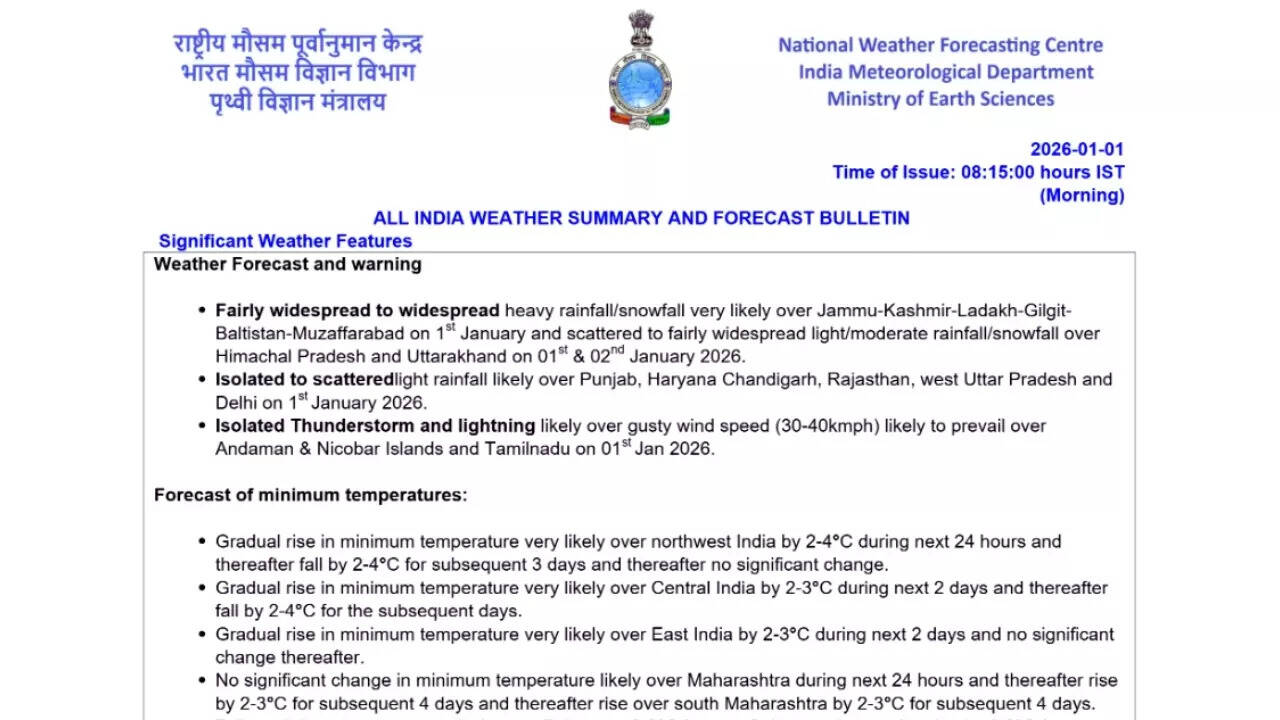
As the country steps into the New Year, weather conditions across several regions of India are expected to remain challenging, with widespread rainfall and snowfall in the western Himalayan region, persistent dense fog over large parts of north and east India, and cold wave to cold day conditions affecting several states. According to the All India Weather Summary and Forecast Bulletin issued on January 1, 2026, a mix of western disturbances, cyclonic circulations, and jet stream activity will shape weather patterns over the coming days, potentially impacting transport, aviation, and daily life.
Heavy rainfall and snowfall in the western Himalayas
The most significant weather activity is forecast over the western Himalayan region, where fairly widespread to widespread rainfall and snowfall are very likely over the region on January 1. Himachal Pradesh and Uttarakhand are also expected to witness scattered to fairly widespread light to moderate rainfall or snowfall on January 1 and 2.These conditions are likely to bring fresh snowfall to higher reaches, which may benefit water resources and winter tourism in the long run but could also temporarily disrupt road connectivity, especially in mountainous areas prone to snow accumulation and landslides.
IMD weather update
Rainfall activity in plains and southern regions
Beyond the hills, isolated to scattered light rainfall is likely over Punjab, Haryana, Chandigarh, Rajasthan, west Uttar Pradesh, and Delhi on January 1. While rainfall amounts in these regions are expected to be modest, the precipitation could further intensify cold conditions and contribute to fog formation during night and early morning hours.In southern India, isolated thunderstorms accompanied by lightning and gusty winds with speeds of 30–40 kmph are likely over Andaman and Nicobar Islands and Tamil Nadu on January 1. The persistence of an upper air cyclonic circulation over the southwest Bay of Bengal, off the Sri Lanka coast, extending up to 3.1 km above mean sea level, is expected to support scattered to fairly widespread rainfall activity over Tamil Nadu and the Nicobar Islands over the subsequent three days.
Dense fog to persist over large areas
One of the most significant weather-related concerns during the opening days of 2026 is the persistence of dense to very dense fog over large parts of north, east, and central India. Dense to very dense fog conditions are very likely to continue during night and morning hours over Odisha, Punjab, Haryana, Chandigarh, and Delhi until January 5. East Uttar Pradesh is expected to experience such conditions until January 2, while west Rajasthan may see dense fog until January 3. Dense fog is also likely at isolated pockets over Himachal Pradesh, Uttarakhand, sub-Himalayan West Bengal and Sikkim, Assam and Meghalaya, and Nagaland, Manipur, Mizoram, and Tripura till January 5. Fog conditions may persist over Uttar Pradesh, Bihar, Punjab, Haryana, Chandigarh, and Delhi until as late as January 7.Several locations in Uttar Pradesh, including Prayagraj, Gorakhpur, Kanpur, and Bareilly, reported zero visibility. Visibility dropped to as low as 50 metres at places such as Tezpur in Assam, Agartala in Tripura, Gaya in Bihar, and Khajuraho in Madhya Pradesh. Even major urban centres such as Bhubaneswar, Varanasi, and Durgapur reported visibility of around 100 metres.
Cold wave and cold day conditions
As per IMD bulletin, cold wave conditions are expected to affect isolated pockets of several states in the coming days. On January 1, cold wave conditions are very likely over Himachal Pradesh and Telangana, while cold day conditions are expected over Punjab, Haryana, Chandigarh, Delhi, and Bihar.From January 2 to January 4, cold wave conditions are forecast to persist at isolated places over Himachal Pradesh, Punjab, Haryana, and Delhi. Rajasthan may experience cold wave conditions on January 5 and 6. These conditions are consistent with observed temperature departures, which show that minimum temperatures across many parts of the country are significantly below normal.
Impact on transport and aviation
The bulletin warns that dense and very dense fog conditions during night and morning hours may significantly impact transport and aviation services. Some airports, highways, and railway routes across affected regions may experience disruptions. Commuters are advised to remain alert, follow travel advisories, and plan journeys carefully during the early morning and late-night hours.