The Rs 40 shot: Inside cough syrup racket hooking teens across states | Lucknow News
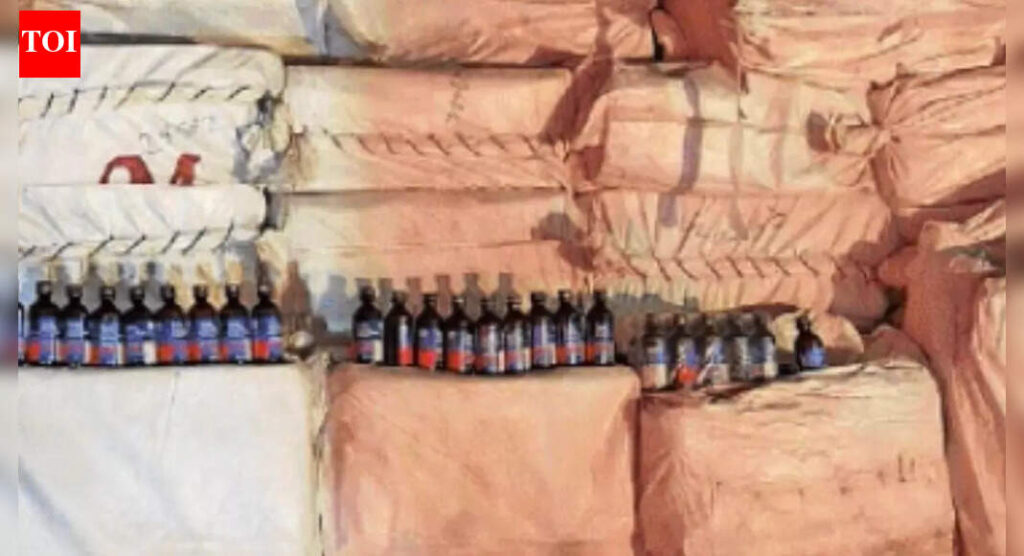
In the crowded bylanes of an east UP town, a small chemist shop with a flickering neon red cross opens its shutters at 11pm. Only regulars know this schedule. A group of boys — some still in their teens — wait at a dimly lit corner, hands in pockets, eyes restless. At the counter, no one asks for a prescription. No one whispers the brand name.The shop attendant takes cash, disappears into the backroom, and returns with tiny plastic caps filled from a 100ml bottle. Each shot sells for Rs 40-60. The bottle itself — legally priced at Rs 120180 — is usually procured as part of consignments that can change hands as many as five times before reaching the shop window. By the end of the night, 20-25 such bottles will be emptied.This is not an isolated urban slum story. From Lucknow to Lakhimpur, Patna to Purulia, Ranchi to Raiganj, and right up to the India-Bangladesh border, codeine-based cough syrups have silently become one of the most profitable narcotics in the region — manufactured at scale, invisibly distributed, and devastatingly addictive.Amid the disturbing case of over 20 children dying due to consumption of adulterated cough syrups in neighbouring Madhya Pradesh, the racket in UP shows how a regulated pharmaceutical pain-relief medication has turned into a multi-crore illicit economy, feeding addiction among teenagers, labourers, and even school students. Over the last year, investigations by UP’s Food Safety and Drug Administration (FSDA), police, Narcotics Control Bureau (NCB) and now the Enforcement Directorate (ED) have revealed the true scale of a problem the country barely acknowledges.Legal Drug, Illegal ChannelsThe issue led to a tug-of-war between the state govt and opposition during the monsoon session early this week. Strongly rebutting allegations by Leader of Opposition Mata Prasad Pandey over ‘deaths’ allegedly due to the consumption of fake medicines and codeine syrup, CM Yogi Adityanath asserted in the assembly that no such case has come to the notice of the state govt so far.Yogi also said that UP just has stockists and wholesalers of codeine-based cough syrup. “It is not produced here, its production takes place in MP, Himachal Pradesh, and other states,” he said.Codeine, derived from opium, is a medically approved opioid. For decades, doctors have prescribed it for severe cough and post-operative pain. It’s classified as a Schedule H drug, which means it requires strict documentation, prescription verification, and controlled distribution.But somewhere along the way, it slipped out of institutional control and into the bloodstream of an entirely different clientele.An NCB official said that codeine-based cough syrups — such as Phensedyl, Corex, Rexcof and Ascoril-D, to name a few — are among the most abused pharmaceutical drugs in India. Although meant to be available only on a Schedule-H prescription, a huge underground market diverts these medicines towards organised smuggling rackets, operating along the UP-Bihar-Bengal corridor, Assam-Tripura-Bangladesh border and Punjab-Haryana routes.Another officer, who has been with NCB, said addicts prefer codeine to illegal narcotics because it is cheaper than heroin and doesn’t involve overt paraphernalia such as needles. That means it doesn’t evoke the same sort of stigma. There are also no street negotiations as it is sold by “respectable” chemists. It is easy to conceal, mixed in soft drink bottles. Which is one reason why it’s popular among teenagers.How A Bottle Goes RogueA standard bottle of cough syrup has to make a long journey: from manufacturer to super-stockist and distributor and, from thereon, to the retailer and, finally, the consumer. The illegal supply chain inserts itself at each of these points, subverting the system from the top down.An FSDA official said that factories in Himachal Pradesh, Uttarakhand and Punjab produce lakhs of bottles monthly. While most comply with regulations, diversion happens through over-production beyond declared quotas, mislabelled cartons handed over to “friendly” transporters, fake destruction certificates for expired batches, and manipulation of batch records. Insiders who spoke off the record said 500-1,000 bottles per shipment can “vanish” without triggering any alarm.A super-stockist is where the pilferage begins, the nerve centre of the racket. Super-stockists control massive inventories meant for entire districts or states. In the UP crackdown, many of these stockists were found linked to shell companies, fake GST numbers, medical stores that existed only on paper, and godowns that changed locations every month. Some of these fictitious firms supposedly “sold” lakhs of bottles. Illicit movement involves mainly duplicate invoices and manipulated stock entries. Goods are supplied to non-existent pharmacies, and consignments redirected to inter-state carriers after office hours.Some chemists sell without prescription, operate “night windows” for addicts, maintain dual registers (audited and real), and buy directly from transporters, bypassing regular supply chains. Across UP districts, authorities found tiny medical shops receiving orders worth Rs 8-15 lakh per month — an impossible figure unless they were wholesale suppliers to illegal networks.How The Racket Was BustedThe countrywide crackdown against the codeine-smuggling syndicate started after police in UP’s Sonbhadra district seized around 1.2 lakh bottles of cough syrup worth Rs 3.5 crore from two container trucks on the Varanasi Shaktinagar road on Oct 18. Thereafter, tipped off by Sonbhadra cops, Ghaziabad police busted a racket on Nov 3, seizing more than 1.5 lakh bottles and arresting eight people. That saw UPFSDA and police in other districts swing into action.UP special task force (STF) officers said intelligence inputs point to illegal trafficking of large consignments of Phensedyl syrup into UP, Uttarakhand, Bihar, Jharkhand, Assam, Bengal and onwards to Bangladesh. In Feb 2024, UP govt had formed a joint STF-FSDA committee to investigate the syndicate after some cases came to light. STF inspector Anjani Kumar Pandey said they arrested two people from Saharanpur — Vibhor Rana and Vishal Singh — on Nov 12. The duo named one Amit Tata, who was traced to Lucknow and is said to have a long criminal history.“Amit said he was drawn into the racket by Vikas Singh of Azamgarh, who introduced him to Shubham Jaiswal of Varanasi, alleged to be a major handler of Phensedyl procurement in Jharkhand under the firm, Shaili Traders,” said Pandey.Roshan Jacob, commissioner, UP FSDA, said that a special headquarters-level team, working with district drug inspectors, has conducted detailed audits of manufacturing units and depots located in Himachal (two firms), Uttarakhand (three firms), Haryana (one depot), and Jharkhand (a super stockist).Kingpin Who Fled To UAEInvestigators in UP identified Varanasi-based pharmaceuticals dealer Jaiswal as the alleged kingpin of the codeine syndicate. Police said that Jaiswal — along with his father Bhola Prasad — engineered a high-volume pipeline for illegal movement of cough syrups using a maze of shell companies. Prasad was arrested from Kolkata airport moments before he was to take a flight to Thailand in the last week of Nov.STF also arrested Alok Pratap Singh, a terminated cop close to Jaiswal. According to Alok, Jaiswal has fled to UAE. He has since filed a petition in HC and uploaded a video on social media claiming innocence. Last week, Allahabad HC dismissed a bunch of writ petitions filed by 23 accused, including Jaiswal, seeking a stay on their arrest and quashing of FIRs against them.Probes have since exposed the inner mechanics of the operation: at least six firms existed only on paper, dozens of documents were forged, and the Ranchi-based Shaili Traders was used for fake billing and inter-state movement. Investigators found that Jaiswal sourced the syrup from a factory in Himachal Pradesh, stockpiled it in Ghaziabad, and pushed it onwards through Agra, Lucknow, and Varanasi, eventually moving consignments deep into the eastern corridor and across borders.“Before Covid-19, Jaiswal was a small-time medical supplier,” an officer said. “During the pandemic, he sensed the rising demand for restricted drugs and partnered with a local strongman to expand his network across states.”The CrackdownA total of 279 medical stores have been inspected across 36 UP districts since Oct this year. During inspections, many establishments were found to be non-existent or operating without stock records, adequate storage, or valid licences. CM Yogi informed UP assembly that 79 cases have been registered so far, in which 225 accused are named. While 78 accused have been arrested, raids have been conducted at 134 firms, he added.Given the enormity of the illegal codeine-based syrup diversion ecosystem, the UP govt has constituted a special investigation team (SIT) headed by an IG-rank officer to go into the matter. Earlier this week, the Bureau of Immigration (BoI) issued Look Out Circulars (LOCs) against Jaiswal, and three other accused.Further, ED has launched a probe under Prevention of Money Laundering Act (PMLA) against 67 accused persons named in 24 FIRs across UP. Meanwhile, Varanasi police has announced a cash reward of Rs 25,000 each for the arrest of Jaiswal and his partner Mahesh Singh. Mahesh is the owner of a warehouse in Varanasi where a raid on Nov 19 yielded a haul of 93,750 bottles of codeine-based syrup worth nearly Rs 2 crore.